
In the rafters of my parents’ unfinished basement sat an ancient pair of skis with screw-on metal edges and Silvretta bindings. They looked like something an Austrian blacksmith forged in the backyard barn. Used at one time, they had long collected dust, stored and neglected for years. Today, the house is gone. So are the skis. But the name Silvretta stuck, exotic in a way I don’t entirely understand.
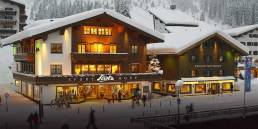
Fast forward a few decades, we’re standing among a throng of Ischgl revellers singing along to Austrian DJ dance beats that defy musical categorization. (Let’s call it infectious obnoxious. Infectious, because my right boot taps the concrete slab in spite of myself. Obnoxious because, well, it is.) Earlier in the day, friendly Germans sharing a lunch table with us at Vider Alp said that Paznauner Taja Lodge is a must-do before the long ski out to the village where the après skiing main course – some of skidom’s most infamous – is served. We took their advice and raised a stein.
Ischgl’s party scene is legendary. Middle-aged men drink like teenagers raiding their parents’ liquor cabinet. Young women in stagette mode pump the air with upturned palms, raising the imaginary roof. Empty bottles roll around underfoot. And when the music stops, hundreds of inebriated skiers, boots half-buckled, goggles askew, stumble to locate skis and poles discarded haphazardly on the snow and on crowded racks.
The ski-out is chaos. I opt for speed and crossed fingers, keeping my Canadian hockey head on a swivel. I’m determined not to get injured before embarking on our goal for coming to Austria – to ski hut-to-hut through the Silvretta Alps of my dreams, a range of mountains traversing western Austria along the Swiss border.
Winter 2026 was savage in the European Alps. In February, heavy snow and strong winds pummeled the mountains, loading a shallow snowpack with a hair-trigger persistent weak layer. By April, avalanches would claim 136 lives, making it one of the deadliest-ever seasons. A few weeks before our planned Silvretta tour, all of Tirol and Vorarlberg were painted red on the avalanche forecast map – four out of five, “high” on the hazard scale, a grim picture for ski mountaineering. Conditions were so touchy that the three huts on the Silvretta tour between Ischgl and the village of Galtür – the Heidelberger, Jamtal and Wiesbadener – closed their doors for more than a week. Staff and guests who hadn’t cancelled hunkered down to eat, drink, and play cards. Then, the weather goddess delivered a warm front and a cycle of house-burying sized avalanches. The snowpack stabilized and, just like that, it was game on.
We’re shoulder to shoulder with resort skiers in the massive Piz Val Gronda Bahn cable car. The sky above is as blue as Margot Robbie’s eyes. Evidence of massive avalanches is everywhere. Crowns, where storm slabs triggered, cut jagged scars across whole mountainsides. Teardrop-shaped fields of debris extend across the valley bottom, some reaching into the ski area boundary. It’s menacing, but also a relief to be venturing off-piste now and not the previous week when alpine faces and couloirs were sprung and loaded.
The Silvretta Tour starts very casually. With good visibility and snow conditions, it’s an easy hour-long downhill ski and gentle traverse from the top of the Piz Val Gronda Bahn to the Heidelberger Hütte. As we arrive, hut manager Alois Eiter is delivering frothy mugs of pilsner and stemmed tumblers of Aperol spritz to the gathering pre-dinner crowd. Eiter is a born joker. Like a lot of people from Tirol, he is Tirolean first and Austrian second, a strong regional affiliation he comes by naturally. His parents ran the Riffelseehütte for 15 years and, as a kid Eiter skied to school in the village of Pitztal. Later, after working in hospitality for a few years in Innsbruck, he returned to his Tirolean roots: he became a mountain guide, then came full circle back to hut life. “I like the social, I like the guests,” he says. “It’s not a job, it’s a passion.”
Supper sets us up for success. Corn and vegetable chowder is followed by roast chicken with risotto, and rich Bavarian cream for dessert. After dinner, I step outside. Stars sparkle brilliantly in a black, cloudless sky, holding promise for the days ahead. A red fox, clearly habituated to humans, scampers across the snow towards the stairs. The animal sniffs the air with a shiny black snout then, like an apparition, disappears into the night. I take it as another harbinger of good things to come.
And come they do. It’s go-time at Kronenjoch. The morning is clear and cold as we skin upwards in a wide valley, gently angled then steepening as we approach the broad Kronenjoch Pass. Ski mountaineers are summiting everything in sight. Parties of skiers disperse in all directions, like long lines of ants marching dutifully toward distant summits and passes. Some are on day trips and others, like us, are bound for Jamtalhütte.
After a snack and water break, we zig-zag upwards on firm snow, threading through rocks where the alpine wind has scoured the slopes of Curuna Lada to bare ground. At the summit, two fit-looking German seniors out for a mountain ramble greet us.
“You have good snow in Canada, no? Why would you come here?” asks the man, who has been a Mike Wiegele heliski guest in British Columbia numerous times, in perfect English and with characteristic German bluntness.
It’s a question we get a lot, requiring increasingly creative responses. I ponder sharing my obsession with Silvrettas, a utilitarian binding designed more for alpine approaches than downhill performance, out of production for at least 10 years. Wisely, I decide otherwise, realizing it would sound absurd to practical Germans. Instead, I offer something lame about huts, history, and the joy of humping our light backpacks through the Austrian Alps. Then I add in a low, hopefully unheard, murmur: “They’re different than the Canadian mountains.”


We rip skins and start the descent, leaving some of our ski bases on rocks protruding from Curuna Lada’s bony flank, an offering of sorts. With time to spare, we grab our backpacks stashed next to a boulder on the broad saddle, then angle eastward around a huge wind scoop toward another summit. It starts with a brief, steep ascent on a well-used but awkward skin track, best suited for someone with a left leg five inches shorter than the right. An airy boot-pack along a narrow snow ridge follows a rocky scramble, awkward in stiff touring boots. Then a 15-minute ski ascent and another rock scramble in boots puts us atop Bischofspitze in the lee of a stout wooden cross.
A dozen scratchy turns and we’re on low-angle, sun-softened snow in the middle of a yawning mountain valley that makes humans feel small. Huge avalanche paths funnel down, like rifle shots from both sides. Natural halfpipes and knolls, carved by long-since-vanished glaciers, make for playful skiing near the valley bottom. Here, a wooden door beneath an overhanging boulder draws our attention. We sidestep over to investigate, but a deep snowdrift blocks us from opening the door to see what lies beyond in the grotto. A simple plaque bolted to the rock honours four men: Georg Munz, Anton Schramm, Helmet Patzig, and Rolf Sandrock. Fatally killed by an avalanche at the Zahnjoch on April 13, 1970, as translated by Google. There’s a mournful finality to the tribute that prompts a moment of involuntary silence, then a sudden urge to move, beyond reach of the huge face below Zahnspitze and Südliches Fluchthorn that claimed these lives more than 50 years ago.
Corn has softened to schmoo when we slide to a stop outside Jamtalhütte. The patio is packed with skiers and boarders enjoying the day’s last rays. I survey the ski rack for vestigial pairs of Silvretta bindings, by now an obsessive ritual of mine. It’s wishful thinking: there are none to be seen. We grab wool blankets and an outside table. Cigarette smoke mixes with savory kitchen aromas. Somehow Europeans still manage to make smoking look cool, even in the mountains. A quartet of boisterous Slovenians at the next table next are well into happy hour. The surrounding chatter is a melding of French, Spanish, Italian, Austrian and, of course, German, a nationality that has left a lasting mark on the Silvretta Alps.
Various chapters of the Deutscher Alpenverein (German Alpine Club) own the three huts along the route. The flagship Jamtalhütte began as a rustic shelter in the 1880s, and underwent numerous additions and improvements over the years. Between the two World Wars, hard-drinking, hard-skiing Ernest Hemingway spent winters in the Montafon Valley and frequently visited with guides and friends. Today the three-storey chalet accommodates 150, with an expansive dining area, indoor climbing wall and yoga room, and a bartender kept very busy on this sunny afternoon. By mountain hut standards it’s palatial, and it’s like home for manager Gerhard Walter. Born and raised in nearby Galtür, members of his extended family have been managing the hut since its inception. However, it took Walter a while to come back home. As a young man he embarked on a decades-long career in tourism that eventually led to him a high-pressure job leading destination marketing for St. Moritz, one of the most affluent resorts in the Alps. In 2024, when his uncle Gottlieb Lorenz was ready to retire from managing Jamtalhütte after 30 years, Walter and his psychologist wife Christina Luis took the reins.
“It was a decision of the heart and a longing for the mountains,” Walter explains simply.
Breakfast is busy as a multinational ensemble of skiers loads up on muesli, yogurt, boiled eggs, bread, and cheese. Two hours later, we’re switchbacking up windblown Chalausferner. Frozen avalanche debris litters the glacier’s shaded surface until we crest a high col into the blaze of morning sun. Two dots are barely visible in the distance, ascending another pocket glacier toward our shared objective: Nördliche Augstenspitze, a 10,600-foot peak that’s easier to climb than pronounce. We meet them on the summit – two women, a German and a Swiss. One of them asks the requisite question: Why did we fly all the way from Canada to ski here? I sweep my hand across the view, as if that’s explanation enough.
Two days later, we’re eating cheese with a group of German splitboarders at Obere Ochsencharte, a windy notch that provides a sneaky exit from Jamtalferner, the largest glacier on the route. We swap stories about Canada and ponder the reward for our efforts, a long and mellow descent to Wiesbadener Hütte. The manager seems grumpy when we arrive. Perhaps the stress of opening, closing, and reopening during the recent extreme avalanche hazard has taken an emotional toll. Per usual, I scan the ski room for Silvretta bindings. Per usual, there are none. I am no closer to understanding my obsession with Silvretta than I was when we started this adventure in Ischgl. Nor am I getting better at responding to the ubiquitous question: As a skier, why leave Canada?
For a Silvretta-style consolation prize on the last day of the tour, we set our sights on the binding’s namesake mountain. A large group of Frenchmen and women whom we had met on the long ascent of Ochsentaler Glacier is now gathered at the base of Silvrettahorn. They look upwards, anxiously. We stash skis, and with crampons and ice axes begin ascending the face, following a deep trench in soft snow. A third of the way up, a large band of rotten, tan-coloured rock bisects the face. A few exposed moves take us to the upper slopes and easier terrain, until the corniced summit ridge. A stomach-churning 500-foot vertical drop plunges climber’s right of the ridge. Far below, Wiesbadener Hütte is a speck on the opposite side of the valley. Piz Buin, a mountain made famous by sunscreen (legend has it the brand’s founder named it so after being badly sunburned during an ascent of the peak) pokes the blue sky at the top of the Ochsentaler. After 15 minutes of exposed ridge climbing, we top the summit. We have it to ourselves.
A light breeze sings through the steel cables that tether a massive wooden cross to the rocks, stoic symbols of Austrian faith. They are placed for many reasons, to mark a first ascent or to commemorate the passing or express gratitude for the safe return of soldiers. It’s easy to understand why the faithful believe that affixing a cross to these lonely heights gets them closer to their God. Indeed, for some, climbing mountains is a metaphysical experience that strips a person bare to their essential being. Ascending this one has finally delivered me closer to answering the quintessential question of this journey: Why bother traversing the Alps when we could do the same back home?
Here in the Silvretta, the history of ski mountaineering and alpine adventure is baked into the landscape. So pervasive is the ethos, it’s easy to forget you’re never far from an Aperol spritz or a sunny hut patio. Though the pulsing après ski of Ischgl may seem like a vision from a different planet, it’s only a few valleys away from lofty Silvrettahorn, a mountain of my dreams. To me, this is the strange and charming appeal of the Austrian Alps. As for my Silvretta obsession, I may have to park it with that dusty old pair of skis in the attic of my memories.